





Mini PC Power Consumption 2026: EU 24/7 Electricity Cost Guide
A mini PC can run a home office, media library or small home server without taking up much space. But if you leave it on day and night, what does that mean for your electricity bill?
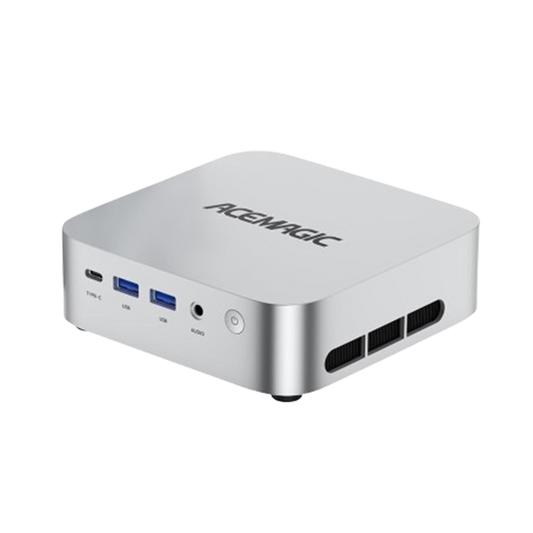
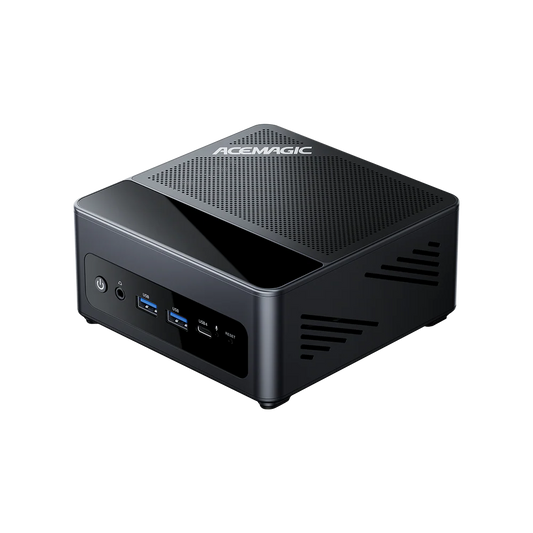
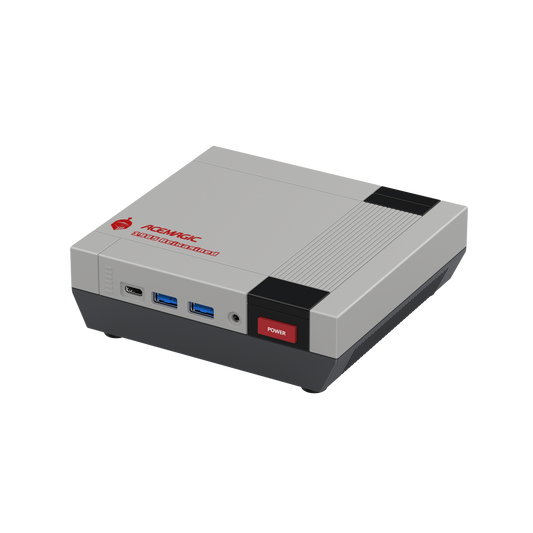
The ACEMAGIC M1 with AMD Ryzen 7 7735HS offers a useful real-world example. Two independent reviews reported different idle power readings: 6.4 W from ChinaMobileMag and approximately 12 W from teltarif.de. If either level were maintained continuously for a year, that works out to approximately €13.68–€25.65 per year at the Netherlands’ H1 2026 example tariff of €0.2440/kWh.
These are separate idle tests, not the measured annual cost of a working server. A machine handling backups, virtual machines or media tasks will move between power states. The best estimate for your own bill uses average power measured at the wall over time.

At a Glance: What Does 24/7 Mini PC Operation Cost?
| Power assumption | Electricity per year | Annual cost in Netherlands* | Evidence type |
|---|---|---|---|
| 5 W, continuously | 43.80 kWh | €10.69 | Illustrative scenario |
| M1 Ryzen 7 7735HS: 6.4 W idle | 56.06 kWh | €13.68 | ChinaMobileMag measurement |
| 10 W, continuously | 87.60 kWh | €21.37 | Illustrative scenario |
| M1 Ryzen 7 7735HS: approximately 12 W idle | 105.12 kWh | €25.65 | teltarif.de measurement (rounded) |
| 20 W, continuously | 175.20 kWh | €42.75 | Illustrative scenario |
All rows assume the stated wattage is maintained for 8,760 hours. Calculated with the Netherlands’ H1 2026 Eurostat household example (€0.2440/kWh). Screens, network switches and external drives are not automatically included. Sources: chinamobilemag.de; teltarif.de.
Why the gap between the two M1 figures? The reviewed machines and methods are not identical: teltarif.de describes a 24GB/512GB test configuration, while the EU shop currently lists a 24GB/1TB configuration. Other variables such as BIOS version and background OS services may also contribute. The reviews do not establish that one particular factor caused the difference. Neither idle reading should be presented as a guarantee for every M1.
Calculate Your Mini PC’s Electricity Cost
A processor’s TDP is not its electricity draw at the wall. To estimate the bill, use the measured wattage of the whole mini PC and its power adaptor, the time it runs, and your own electricity tariff.

Annual electricity (kWh) = average wall watts × running hours ÷ 1,000
Annual electricity cost (€) = annual kWh × variable tariff (€/kWh)
For example, a machine averaging 10 W all year uses 10 × 8,760 ÷ 1,000 = 87.6 kWh. At €0.30/kWh, it costs €26.28 per year.
| Enter your own numbers | Value |
|---|---|
| Average power measured at the socket | ______ W |
| Hours per day | ______ |
| Days per year | ______ |
| Variable electricity price | €______ / kWh |
| Annual electricity = W × hours/day × days/year ÷ 1,000 | ______ kWh |
| Annual bill attributable to this device | €______ |
For contracts with peak and off-peak pricing, calculate each time band separately. Do not add your household’s fixed supply charge as though the mini PC created that charge. In a typical home-office schedule (15 W for 8 hours per weekday, 52 weeks; zero power assumed outside work), the example cost is €7.61/year at €0.2440/kWh. That is a calculated scenario, not a K1 or M1 test result.
Mini PC vs Other Homelab Hardware: What Can You Actually Compare?
It’s tempting to claim that a mini PC always costs less to run than an NAS or a desktop. The data do not support a universal ranking: reviews measure different devices, tasks, and accessories. The examples below use named published figures where available and label hypothetical systems separately.
| Example and operating state | Power used for calculation | Annual bill at €0.2440/kWh | Measurement status |
|---|---|---|---|
| ACEMAGIC M1 Ryzen 7 7735HS, idle (ChinaMobileMag) | 6.4 W | €13.68 | Independent review; idle |
| ACEMAGIC M1 Ryzen 7 7735HS, idle (teltarif.de) | approximately 12 W | €25.65 | Different independent review; approximate idle |
| Beelink Mini S12 Pro (Intel N100), external-monitor idle test (Notebookcheck) | 9.02 W | €19.28 | Independent review; brief idle test |
| Synology DS223, disk access (manufacturer specification) | 17.343 W | €37.07 | Manufacturer-rated access draw, not idle or average |
| 40 W continuously, e.g. a hypothetical older desktop setup | 40 W | €85.50 | Illustrative only; not a desktop benchmark |
| 80 W continuously, e.g. a hypothetical larger server setup | 80 W | €171.00 | Illustrative only; not a server benchmark |
Each annual amount is a mathematical “if this wattage persisted all year” result. The measurements are neither matched conditions nor actual 24/7 averages, and must not be read as an efficiency leaderboard.
Sources: notebookcheck.net; synology.com.
The practical question isn’t whether an older desktop must use 40 W, but whether your existing machine’s measured average draw is meaningfully higher than your proposed replacement’s. Only then can you estimate the actual saving. For a 24/7 system at the Dutch example rate, every 1 W reduction in average power saves about €2.14 per year (1 W × 8760 h × €0.2440/kWh ÷1000).
Running Cost & Carbon Emissions Estimate
Electricity also has an emissions impact. You can use the same annual kWh figure to produce a rough illustration of emissions associated with electricity generation, as long as you do not describe it as a device’s full carbon footprint.
Illustrative generation-related emissions (kg CO₂e) = annual kWh × 0.18344 kg CO₂e/kWh
The 0.18344 kg CO₂e/kWh factor represents the 2024 EU average greenhouse-gas emissions intensity of electricity generation, as reported by the European Environment Agency (EEA). It is a 2024 generation-average reference applied here to 2026 energy-use scenarios—not a 2026 national grid factor, supplier-specific factor or product life-cycle assessment. It does not include manufacturing the computer or a complete accounting of transmission, imports and consumption-based electricity supply.
| Hypothetical constant draw | Annual electricity | Illustrative EU-average generation emissions |
|---|---|---|
| 6.4 W (M1 review’s idle state) | 56.06 kWh | 10.28 kg CO₂e/year |
| approximately 12 W (another M1 review’s approximate idle state) | 105.12 kWh | 19.28 kg CO₂e/year |
| 10 W average | 87.60 kWh | 16.07 kg CO₂e/year |
Source: eea.europa.eu. Country-specific grids differ substantially; these values are illustrative, not certified carbon accounting. Never use the earlier unsupported 0.231 kg CO₂e/kWh coefficient for this article.
Europe Isn’t One Electricity Market
To show how much the tariff matters, we use Eurostat H1 2026 prices for household customers in the 2,500–4,999 kWh/year consumption band, in euro per kWh, including taxes and levies. These are national statistical averages, not the price on everyone’s bill.
| Country | Eurostat H1 2026 example tariff | M1: 6.4 W idle all year | M1: approximately 12 W idle all year |
|---|---|---|---|
| Netherlands | €0.2440/kWh | €13.68 | €25.65 |
| Sweden | €0.3062/kWh | €17.17 | €32.19 |
| Belgium | €0.3575/kWh | €20.04 | €37.58 |
The EU-wide household figure for the same statistical category was €0.2832/kWh, but it does not represent a uniform EU electricity tariff. Use your own marginal per-kWh price for decisions.
Source: ec.europa.eu.
A Realistic 24/7 Homelab Is Neither Always Idle nor Always at Full Load
The ChinaMobileMag M1 review reported 6.4 W idle, 40 W during a CPU-only load, 46.7 W during a GPU-only load, and up to 44.5 W under its combined CPU-and-GPU test. These are distinct test conditions; the apparently lower combined-load value is not a mathematical contradiction.
Consider a deliberately simplified day: 23 hours at 6.4 W and one hour at 40 W. Across 365 days, that produces 68.33 kWh, or approximately €16.67 at the Netherlands example tariff. This is a calculation built from published endpoint measurements, not a separately measured daily test.
You can replace those figures with your own two-part schedule:
Daily kWh = (idle watts × idle hours + active watts × active hours) ÷ 1,000.
Even this model has limits: backups, network traffic, and virtual machines create different levels of activity. For the best annual estimate, run a plug-in meter for several representative days and use the recorded total kWh to derive average power.
What Affects Idle and Average Power?
The CPU name is only one part of the picture. RAM and SSD configuration, network controllers, attached disks, display output, USB accessories, BIOS power settings, and the operating system all change the wall reading. A monitor used at a desk should be included in the desk’s electricity estimate, but not automatically added to a headless home-server figure.
There is no universal wattage for “an N100 mini PC”, “an old i5 desktop” or “an entry NAS”. A component-level TDP or a power-brick rating is not a substitute for a measured whole-system reading. And an empty homelab will not always behave like one running media transcodes, backups and several VMs.
Measure Your Own Mini PC in Five Steps
- Connect a plug-in energy meter between the mains socket and the mini PC’s power adaptor so adaptor losses are included.
- Record the exact CPU, RAM, SSD, BIOS and OS power mode, plus connected peripherals.
- After startup settles, log the idle reading; then run the applications or home-server services you normally use.
- Leave the meter connected for a few days and record cumulative kWh, not only a momentary peak.
- Derive average power: average W = measured kWh ÷ measurement hours × 1,000. Use that result in the annual cost formula.
For example, 0.24 kWh over 24 hours is a 10 W average. If your energy contract varies by time of day, combine your consumption with the matching tariffs.
Buying an Efficient Mini PC: K1 Ryzen 7 7730U or M1 Ryzen 7 7735HS?
The running-cost calculation is useful, but a buying decision also depends on RAM capacity, graphics needs, connectivity and workload. Here we refer to two specific EU-store configurations, rather than using the names “K1” or “M1” without a processor.

| Item | ACEMAGIC K1 Ryzen 7 7730U | ACEMAGIC M1 Ryzen 7 7735HS |
|---|---|---|
| Processor | 8 cores / 16 threads, Zen 3 | 8 cores / 16 threads, Zen 3+ |
| Integrated graphics | Radeon Vega-class graphics | Radeon 680M |
| EU listing selected | 16GB LPDDR4X + 1TB SSD | 24GB LPDDR5 + 1TB SSD |
| RAM upgrade | Onboard, non-upgradeable | Onboard, non-upgradeable |
| Exact-model idle evidence used here | No verified result | Two reviews: 6.4 W and approximately 12 W |
| More natural fit | Routine office work and lighter services | Heavier multitasking, media workloads and smaller labs |
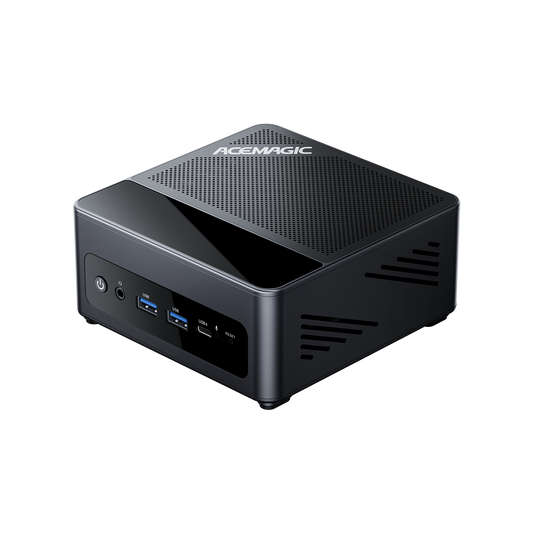
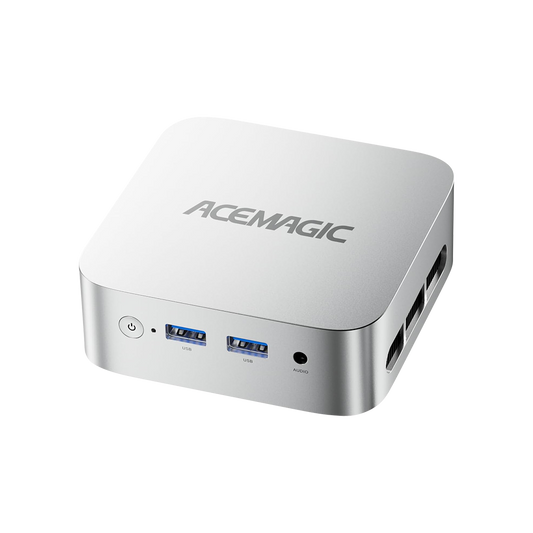
The ACEMAGIC K1 Ryzen 7 7730U is a straightforward compact desktop for everyday tasks and light services. It should not inherit the 4.7–5.3 W idle measurement from reviews of a different K1 processor variant; this article makes no power-consumption claim for the 7730U configuration.
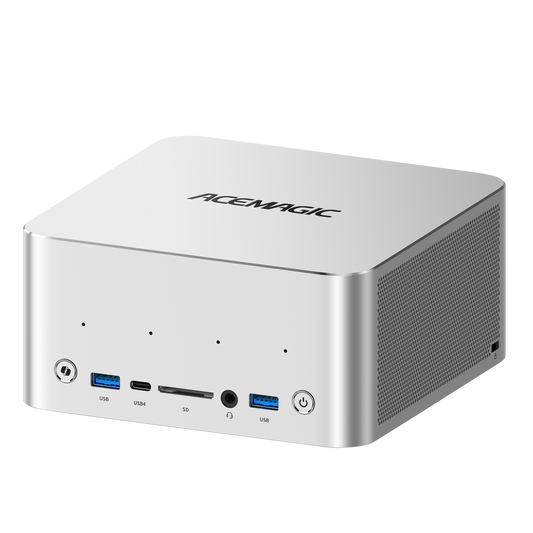
The ACEMAGIC M1 Ryzen 7 7735HS adds Radeon 680M graphics and more included memory. That makes it worth considering for multitasking and small home labs—provided you confirm your software, storage and networking needs. Its independent idle results offer useful evidence, but the test configurations and your own installed services can change the outcome.


Which would we choose? Start with the K1 Ryzen 7 7730U for less demanding office use if the fixed 16GB RAM is sufficient. Consider the M1 Ryzen 7 7735HS when the extra memory and graphics capability matter. If 24/7 efficiency is your overriding goal, get a like-for-like measurement of the exact configurations before deciding which is cheaper to operate.

Explore the mini PC collection, or see the German mini PC buying guide. For a software setup example, read our guide on how to install Proxmox VE on a mini PC.
A Quick Pre-Purchase Check for a 24/7 Home Server
- Is your planned workload mostly idle, or will VMs, media transcoding, and backups stay busy?
- How much RAM and storage will the services need in a year or two? Both configurations above have fixed onboard RAM.
- Do you need Radeon 680M graphics, or is a simpler integrated GPU enough?
- Will an external SSD, HDD, USB hub or network switch add to the whole setup’s power consumption?
- Can you find independent wall-power data for the exact CPU and configuration you plan to buy?
Final Verdict
A mini PC can be economical to leave on, but there is no reliable “one wattage fits all” answer. For the M1 Ryzen 7 7735HS, two independent reviews reported 6.4 W and approximately 12 W at idle. These translate to approximately €13.68 and €25.65 a year at the Dutch H1 2026 example tariff only if the machine remains at that idle draw throughout the year.
Real office and homelab costs depend on average wall power, usage hours and local electricity prices. Measure your setup if the difference matters to your purchase. Then choose between the K1 Ryzen 7 7730U and M1 Ryzen 7 7735HS for the performance and capacity you need—not on CPU TDP alone.
Frequently Asked Questions
How much does a 10 W mini PC cost to run 24/7 in Europe?
At a constant 10 W, it uses 87.6 kWh a year. That costs €21.37 in the Netherlands, €26.82 in Sweden or €31.32 in Belgium using the H1 2026 Eurostat examples. These are modelled costs, not a particular machine’s annual meter reading.
Is 6.4 W the ACEMAGIC M1 Ryzen 7 7735HS’s normal idle power?
It was measured by one independent reviewer. Another review of an M1 Ryzen 7 7735HS measured approximately 12 W at idle. Use both as evidence of variability and measure your own configuration rather than claiming a guaranteed 6.4 W.
How much power does the K1 Ryzen 7 7730U use?
A directly comparable, independently verified whole-system idle figure for the 7730U configuration has not been established here. Do not reuse measurements from a K1 fitted with another Ryzen processor.
Does a 65 W power adaptor mean 65 W of constant electricity use?
No. The adaptor’s rating indicates capacity. Actual wall draw depends on what the computer and accessories are doing. Measure it at the socket.
Is the 10.28 kg CO₂e figure the mini PC’s full carbon footprint?
No. It is an illustrative generation-related electricity-emissions estimate: 56.064 kWh multiplied by the EEA’s 2024 EU-average electricity-generation intensity of 0.18344 kg CO₂e/kWh. It does not account for manufacturing, transport, disposal or the household’s actual electricity mix.
Can a mini PC replace an old desktop or a dedicated NAS?
Sometimes, but check services, storage connectivity, backup needs, performance and operating cost. A table of unrelated idle figures does not prove the annual saving for your particular setup. Compare measured average watts, including drives and relevant accessories.
Sources and Measurement Notes
- chinamobilemag.de. Wall-socket idle, load and standby-limit measurements; reviewed device with one SSD, mouse and keyboard.
- teltarif.de. Approximately 12 W idle; reviewed configuration includes 24GB LPDDR5 and 512GB SSD.
- notebookcheck.net. Published 9.02 W average idle (external-monitor test condition).
- synology.com. Manufacturer-listed 17.343 W during disk access; not an independently measured 24/7 average.
- ec.europa.eu. H1 2026, household consumption band DC (2,500–4,999 kWh/year), EUR/kWh including taxes and levies; NL €0.2440, SE €0.3062, BE €0.3575, EU €0.2832. ec.europa.eu. Dataset definitions and household-price methodology.
-
eea.europa.eu. 2024 EU average: 183.44 g CO₂e/kWh; electricity-generation emissions intensity, not lifecycle or consumption-specific footprint.